10 Basic Shapes Tracing Worksheets: A Gateway to Early Learning Success
For educators and parents seeking effective tools to introduce foundational learning concepts to preschool and kindergarten children, the 10 Basic Shapes Tracing Worksheets offer a structured and engaging solution. Designed with young learners in mind, this printable resource supports early cognitive and motor development through simple, focused activities that build essential skills.
Why Shape Recognition Matters in Early Childhood Education
Understanding basic shapes is a critical early learning milestone. It lays the groundwork for more advanced concepts in geometry, reading, and writing. Children begin recognizing shapes through play and observation, but intentional practice through tracing reinforces their understanding and prepares them for future academic tasks.
However, many early childhood educators and parents face challenges in finding age-appropriate materials that balance learning with engagement. Young children often struggle with pencil grip, hand-eye coordination, and attention span, making it essential to provide resources that are both developmentally appropriate and visually appealing.
How the 10 Basic Shapes Tracing Worksheets Help
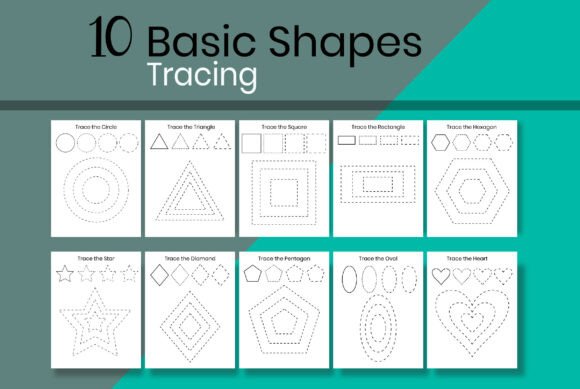
The 10 Basic Shapes Tracing Worksheets set addresses these challenges by offering a progressive, child-friendly approach to shape learning. Each worksheet isolates a single shape—such as circles, squares, triangles, rectangles, ovals, stars, hearts, diamonds, pentagons, and hexagons—allowing children to focus without visual overload.
These worksheets are not just about shape recognition. They are carefully crafted to support:
- Fine motor development – through tracing exercises that strengthen hand muscles and improve dexterity
- Pencil control – helping children gain confidence in holding and maneuvering writing tools
- Pre-writing skills – laying the foundation for letter and number formation
- Visual discrimination – training the eye to distinguish between similar shapes
Practical Applications Across Learning Environments
One of the standout features of the 10 Basic Shapes Tracing Worksheets is its versatility. Whether used in a traditional classroom, homeschool setting, or during independent learning time, these worksheets integrate seamlessly into daily routines.
Here are a few practical ways to incorporate them:
- Homeschool activities – Use as part of a structured morning routine or as a warm-up before reading and math lessons.
- Learning centers – Place printed sheets in a fine motor or independent work station for self-paced practice.
- Homework reinforcement – Assign as extra practice for students needing additional support with shape identification and motor control.
- Parent-teacher collaboration – Share with families as a supplemental tool to extend learning beyond the classroom.
What Makes This Resource Unique?
Unlike generic shape worksheets that may overwhelm young learners with too much visual input, the 10 Basic Shapes Tracing Worksheets are intentionally designed with simplicity in mind. Each page features bold, clear lines and minimal distractions, allowing children to focus on the task at hand.
Additionally, the set is available in both PDF and PNG formats, making it easy to print or use digitally on tablets with stylus support. The print-and-go layout eliminates the need for cutting, laminating, or special preparation, saving educators and parents valuable time.
Supporting Different Learning Styles and Paces
Children learn at different rates and in different ways. The 10 Basic Shapes Tracing Worksheets accommodate a variety of learning styles by offering a multi-sensory experience:
- Visual learners benefit from clearly defined shapes and consistent patterns.
- Tactile learners engage through the physical act of tracing and drawing.
- Kinesthetic learners gain from the hand movements required during practice.
Because each worksheet can be revisited multiple times, children can progress at their own pace. Repetition builds confidence and mastery, which is especially important for those who may struggle with fine motor coordination.
Setting the Stage for Future Learning
Early exposure to shapes does more than teach children to identify circles or triangles. It supports spatial reasoning, which is vital for later math and science learning. It also enhances reading readiness, as shape recognition helps children distinguish between letters that have similar forms, like “b” and “d” or “p” and “q.”
The 10 Basic Shapes Tracing Worksheets act as a bridge between play-based learning and formal education. By turning abstract concepts into tangible practice, they make foundational learning accessible and enjoyable.
Maximizing the Benefits: Tips for Parents and Educators
To get the most out of the 10 Basic Shapes Tracing Worksheets, consider the following tips:
- Start with large motor practice – Before tracing, have children draw shapes in the air or with sidewalk chalk to build muscle memory.
- Use multisensory tools – Place the worksheet in a clear sleeve and let children trace with dry-erase markers or textured materials for added sensory input.
- Encourage verbalization – Ask children to name each shape as they trace to reinforce language development.
- Track progress – Keep completed worksheets in a folder to show improvement over time, which boosts motivation and self-esteem.
- Pair with real-world exploration – Connect shape learning to everyday objects, like finding circles in wheels or squares in windows.
Conclusion: A Foundational Tool for Lifelong Learners
The 10 Basic Shapes Tracing Worksheets are more than just printable pages—they are a stepping stone to confidence, coordination, and cognitive growth. By combining educational value with engaging design, this resource supports early learners as they develop the skills necessary for future academic success.
Whether used in the classroom or at home, these worksheets offer a flexible, effective way to introduce foundational concepts in a manner that feels fun and achievable. For educators and parents committed to nurturing young minds, the 10 Basic Shapes Tracing Worksheets are a valuable addition to any early learning toolkit.